Part 1 of 3 in our series, The Geometry of How Much, following Johannes Kepler and his wine barrels.
Every cellar has the same quiet question running in the background: how much wine is actually in that barrel? It sounds simple. It has been surprisingly hard for about 400 years, and one of the first people to take it seriously was an astronomer.
A Wedding, a Wine Merchant, and a Stick
In 1613, Johannes Kepler, the man who worked out how planets move, was getting married for the second time in Linz, Austria. Like any good host, he bought wine for the celebration.
Then he watched how the merchant priced it. The merchant pushed a single measuring rod through the bung hole on top of the barrel, angled it down to the far bottom edge, read the number, and charged accordingly. Same rod, same method, for every barrel, whatever its shape.
Why It Bothered Him
Kepler spotted the problem right away. A tall, narrow barrel and a short, wide one could give the exact same rod reading while holding very different amounts of wine. If the rod couldn’t tell them apart, someone was paying for wine they weren’t getting.
So instead of just enjoying his wedding, he went home and started doing geometry.
What Kepler Found
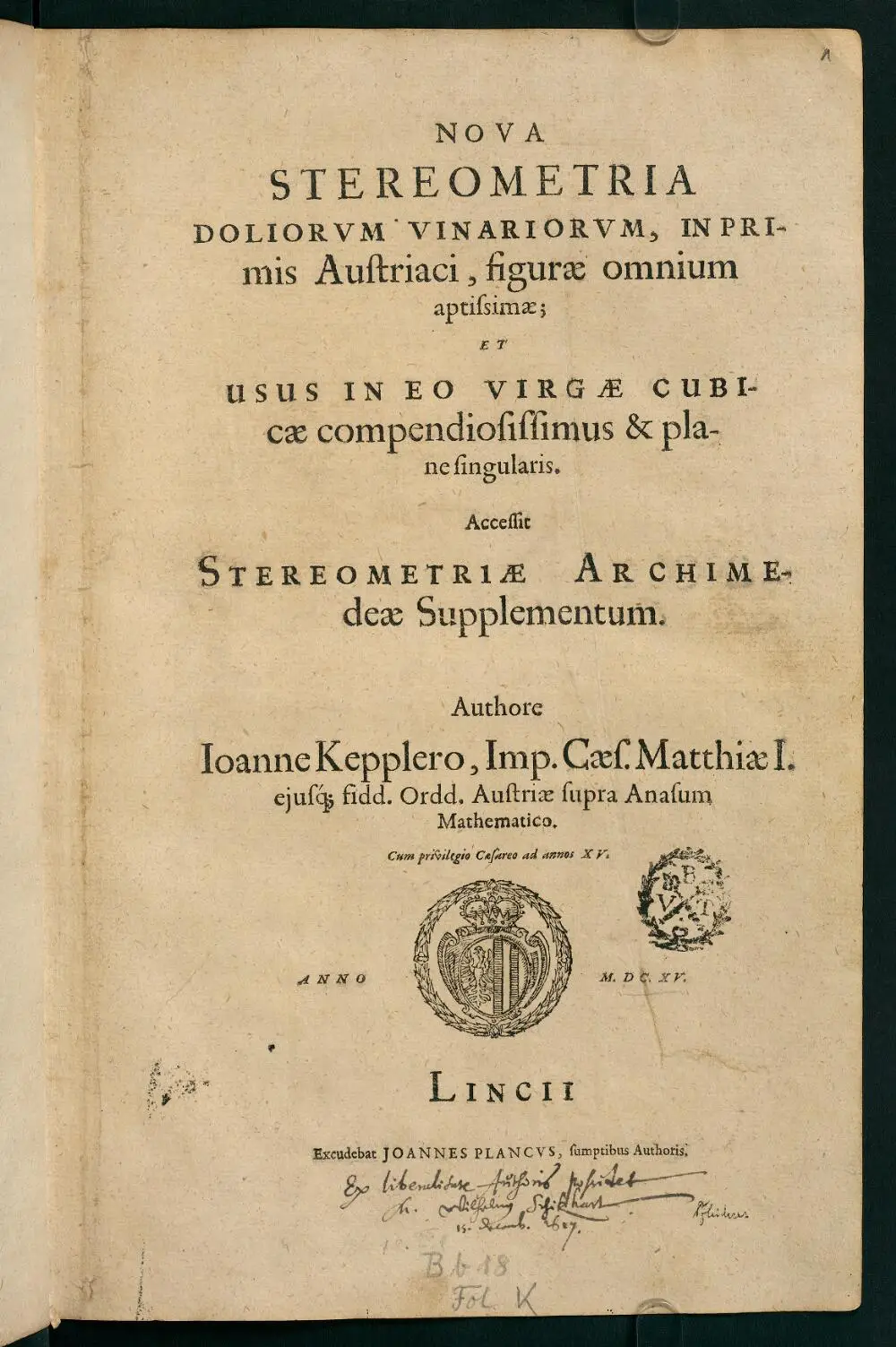
Two years later, in 1615, he published a book whose title translates to New Solid Geometry of Wine Barrels. He couldn’t find a printer for it, so he brought one to Linz and paid for it himself, making it the first book ever printed in that city.
He didn’t stop at barrels, either. The book wanders through the volumes of all kinds of rounded shapes, from apples to lemons, and historians now count it among the early steps toward calculus.
And the twist? He showed that the Austrian barrels of his day happened to be shaped almost perfectly for the merchant’s shortcut. For a given rod reading, that shape held close to the most wine possible, so the stick was nearly right after all. Nearly.

Kepler’s Corner
Meet Johannes Kepler (1571–1630)
- Best known for his three laws of planetary motion, which describe how planets travel around the sun.
- His barrel book, Nova Stereometria Doliorum Vinariorum, was the first book ever printed in Linz, and he paid for it himself.
- He said in the book’s dedication that his second marriage is what started the whole project.
- It took until 2018 for the full book to be translated into English.
The Question Hasn’t Gone Away
Four centuries later, barrels still aren’t simple shapes, and cellars still need to know what’s in every one, for blending, planning, and clean records. Most of the time, that still means opening something up and taking a look.
That’s the question we care about at Hodgins Holdings: how much is in there, without opening it?
Coming in Part 2, “The Barrel That Was Almost Perfect”: how Kepler proved the Austrian barrel was shaped just right, and why that little bulge in the middle matters more than you’d think. Then Part 3, “From Wine Barrels to Planets”: how one curious mind went from measuring wine to mapping the heavens.
Sources
- Mathematical Association of America, Convergence: Kepler and the volume of a wine barrel
- Wolfram MathWorld: Kepler’s Wine Barrel Problem